The Northshore Guide: Understanding the 5 Stages of Tooth Decay
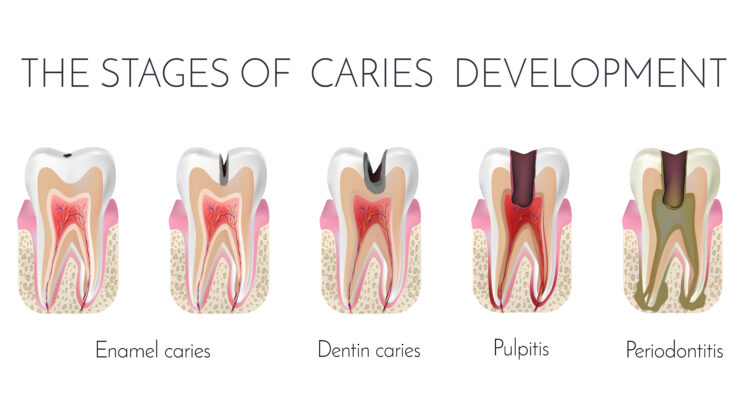
At Northshore Dental, we believe that education is the first line of defence against dental problems. Tooth decay does not happen overnight. It progresses through five clear stages, moving from minor surface wear to deep root infections.
By understanding this timeline, our patients can catch issues early, protect their smiles, and avoid complex treatments.
Stage 1: Superficial
-
- Overview: This is the absolute beginning of enamel erosion. When food acids and plaque bacteria constantly attack the tooth, the outer surface begins to lose vital minerals.
- Clinical Presentation: Small, chalky white spots form on the tooth.
- Symptoms: Completely asymptomatic. There is no pain or sensitivity at this point.
- The Northshore Solution:This is the only stage where decay is fully reversible. If detected during your routine 6-monthly check-up, our oral health team can re-mineralise the area using professional, high-strength topical fluoride applications or protective dental sealants. No drilling is required.
Stage 2: Enamel Erosion (Early Cavity)
-
- Overview: If demineralisation is left unchecked, the hard outer enamel breaks down completely. The structural integrity of the surface is lost, and a physical micro-cavity forms.
- Clinical Presentation: The white spots turn into a noticeable light brown or yellowish lesion.
- Symptoms: The tooth may start to feel mildly sensitive when exposed to sweets, hot liquids, or cold Sunshine Coast sea breezes.
- The Northshore Solution: Because enamel cannot regenerate once a physical hole forms, the decay must be treated. Our team will gently remove the compromised structure and place a tooth-coloured composite filling that blends seamlessly with your natural smile.
Stage 3: Dentin Decay
-
- Overview: The decay breaches the enamel and enters the dentin—the softer, porous layer directly beneath. Dentin contains thousands of microscopic tubes leading straight to the nerve. Because it is much softer than enamel, decay accelerates rapidly once it reaches this zone.
- Presentation: The cavity expands significantly, showing a distinct dark brown or black colour.
- Symptoms: Patients usually experience sharp, lingering pain and heightened sensitivity while eating or drinking.
- The Northshore Solution: Immediate intervention is required to save the structural integrity of the tooth. Depending on the spread of the decay, we will restore the tooth using a custom dental filling or protect it with a durable, long-lasting dental crown.
Stage 4: Pulp Damage (Nerve Damage)
-
- Overview: The infection penetrates deep into the heart of the tooth, known as the pulp. This internal chamber houses the tooth’s living nerves and blood supply. The bacterial invasion causes severe inflammation, cutting off blood flow and causing the nerve to swell inside a hard, unyielding space.
- Presentation: Extensive structural breakdown of the tooth crown, often accompanied by red, inflamed gum tissue surrounding the area.
- Symptoms: Constant, severe, and throbbing pain that persists without any trigger, frequently keeping the patient awake at night.
- The Northshore Solution: To relieve the intense discomfort and save the natural tooth from extraction, our experienced clinical team must perform Root Canal Therapy. We carefully remove the infected pulp tissue, sanitise the internal canals, and seal the tooth before strengthening it with a protective crown.
Stage 5: Abscess Formation
-
- Overview: Once the pulp completely dies, the bacterial infection travels past the tip of the root canal system and leaks into the surrounding jawbone. This triggers an acute inflammatory response, creating a localized pocket of pus at the base of the root.
- Presentation: Visible swelling of the gums (often looking like a pimple), cheek, or jaw line, sometimes accompanied by swollen lymph nodes in the neck.
- Symptoms: Excruciating, radiating pain, a foul taste in the mouth, bad breath (halitosis), and occasionally a systemic fever.
- The Northshore Solution: This is considered a dental emergency. Our priority is to eliminate the infection immediately to protect your systemic health. Treatment requires urgent root canal therapy to drain the abscess, alongside targeted antibiotics. In cases where structural damage is too catastrophic, a gentle tooth extraction followed by a dental implant or bridge will be recommended.